
Panchratna Kanya
The Panchratna sisters in Dada’s journey of art
The journey of sculptor Babi Bandekar’s art is not only the story of one artist’s gift. It is the journey of a whole family that joined art to values, tradition to labour, and devotion to a spirit of service. Walking in Dada’s footsteps, under his guidance and in the shade of his craft, his five daughters — Pratibha, Vimal, Manisha, Hema and Trupti — became the five pillars of his workshop.
Dada did not teach them the technique of sculpting alone. He taught the discipline behind shaping an idol, the fine points of drawing, an eye for colour, planning and running the workshop, the skill of drawing fine work from artisans, the art of speaking with Ganesh mandals with warmth, and the commitment to finish accepted work on time.
More important still, Dada gave them the value of binding people together. To speak with everyone in love, harmony and courtesy; to keep the other person’s honour; and however large the duty, to carry it quietly and from the heart — all this they took in from being with Dada.
That is why these five sisters are not merely people who work in Dada’s workshop. They are fellow travellers of his artistic legacy, bearers of his values, and Panchratna dedicated to the service of Ganaraya.
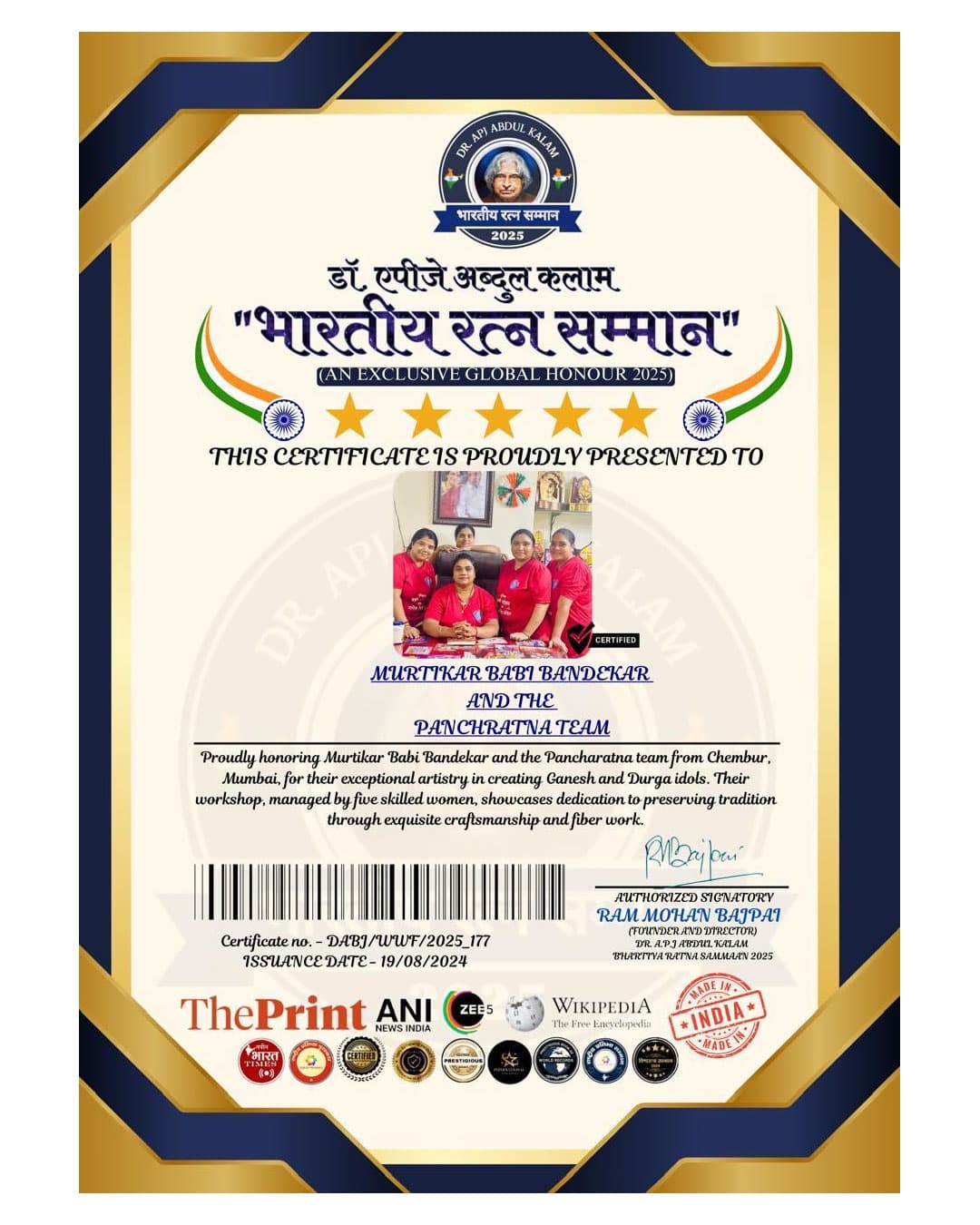

Pratibha
The elder sister of the workshop
Pratibha, eldest daughter of sculptor Babi Bandekar, is the elder sister of the workshop. Her stature is not only because she is the eldest, but because of her way of taking on whatever duty Dada named and seeing it through to completion.
She firmly holds the important charge of seeing Ganpati work of every size — large and small — done in good order. On one side the rhythm of the great idols, on the other the fine points of the small — bringing both into harmony and finishing on time is her special skill.
Drawing, too — above all the lining of Ganaraya’s eyes — is a most beautiful and distinctive part of her art. Under Dada’s guidance she made this style her own. In those eyes there is not only form; there is feeling, serenity, a compassionate look toward the devotee, and the life that makes the murti living. Pratibha learned from Dada the art of shaping that life through the line.
While keeping the style of Dada’s hand, she also grew the finish of her own. So the drawing that comes from her hand is a beautiful joining of Dada’s values and her own sadhana.
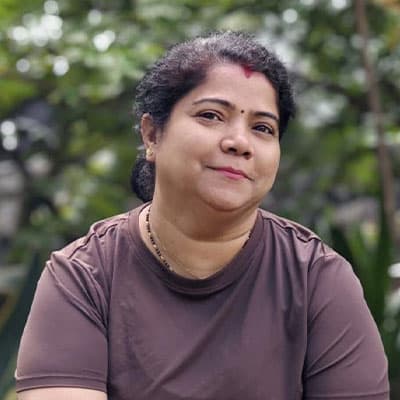
Vimal
Steadfast companion and the workshop’s discipline
Vimal Tai is the workshop’s steadfast, trusted companion. Standing shoulder to shoulder with the elder sister, and carrying every duty that comes without fuss — that is her mark.
Workshop management, the order of work, drawing, lining Ganaraya’s eyes, ornament of the murti, and the other needed tasks she holds with ease and warmth.
When many murtis take shape at once, each task needs the right time, the right person and the right order. Then Vimal Tai’s sense of management and her close eye on the work become especially important.
There is a quiet strength in her work. Whether the duty is large or small, she is always ready to finish it as her own. The discipline and sense of duty Dada gave her can be felt in every task she does.

Manisha
Ganaraya’s form opening through colour and cloth
In the workshop Manisha Tai is an important hand in colour and ornament. She takes a wholehearted share in painting Ganesha. She works with care so the murti’s form opens more fully, so the colours suit its character, and so every part receives its proper lift.
Beautiful cloth-work for Ganaraya is another special side of her work. Dressing a murti is not only attaching cloth; through it Ganaraya’s beauty, grace and royal presence must open. With that eye she gives shape to the draping.
Along with painting and cloth-work she also carries workshop duties of many kinds, just as easily. A beautiful balance of the artist’s touch and the discipline of management shows in her work.
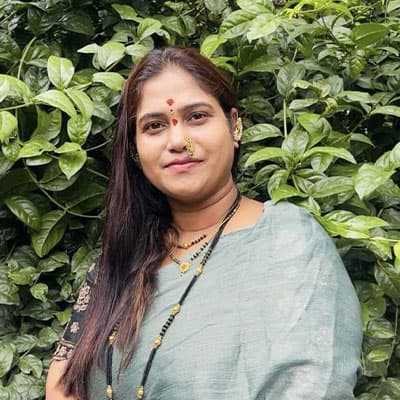
Hema
Sole steward of the world of colour
Hema Tai is, as it were, the sole steward of the world of colour in Babi Bandekar’s workshop.
The whole charge of painting rests in her hands. Yet her work begins before the painting itself. Whether every machine, the gear needed for colour, the materials and tools are ready — that preparation she keeps as her own duty.
Every stage of painting the murti passes under her close eye. Choosing hues, joining them rightly, giving the form lift through shading, and opening the feeling on the face — in all this her labour and her artist’s eye are felt.
But her duty is not limited to painting. Along with colour she holds workshop management, coordination with artisans, the order of needed work, ornament of the murti, and the many things required to finish on time — all with ease.
Behind every tint of colour is her labour, behind every shading her skill, and behind every finished murti the discipline of her management. Hema Tai, who carries Dada’s artistic values forward through colour, is a vital strength of the workshop.

Trupti
The sister who opens Ganaraya through colour and ornament
Trupti Tai is another vital link who holds, with warmth, the duties of painting, cloth-work and management in the workshop.
Taking a wholehearted share in painting Ganesha, she works with care so beauty is added to the murti, every part receives its proper lift, and the finished form looks more serene.
In beautiful cloth-work and ornament for Ganaraya, the eye in her hand is felt. She has an important share in the process that gives the murti completeness through cloth, jewellery and decoration.
Along with this she also carries many kinds of workshop duty with ease. Giving a helping hand where needed, keeping the pace of work, and finishing what is given on time — in all this her role is important.
Five sisters — one value, one resolve
Pratibha, Vimal, Manisha, Hema and Trupti — five natures, five different duties; yet in the mind one Dada, before the eyes one world of art, and in the heart one Ganaraya.
One sets feeling into Ganaraya’s eyes by drawing; one sets the workshop’s scattered order right again; one makes the murti living through tints of colour; one opens its form through cloth-work and ornament; and one finishes countless tasks behind the curtain without a word.
All five sisters learned art from Dada, but greater still, they learned the values of art. They learned work, and with it loyalty to work. They learned management, and with it the art of keeping people. And in adorning Ganaraya they did not only make the murti beautiful; they carried forward the beauty of the tradition Dada had shaped.
That is why these five sisters of Babi Bandekar’s workshop are not five daughters alone —
They are five directions of Dada’s art, five forms of his values, five lamp-flames of his tradition, and, flowing without break in Ganaraya’s service — they are his Panchratna Kanya!
Behind the countless forms of Ganaraya shaped by Dada’s hands, an invisible yet priceless signature of these Panchratna sisters — their labour, love, discipline and offering — is stamped forever.
At the Workshop
The Panchratna Kanya at work — shaping clay, colour, and devotion in Chembur.